- Feb 7
Rhythm, Repetition, and Intention: How Simple Drawing Can Support Relaxation
- Alina Smolyansky
- NeuroGraphica and NeuroArt
- 0 comments
When the body is under stress, it often responds instinctively with rhythm and repetition.
A foot tapping on the floor.
A baby soothed by gentle rocking.
A steady, repetitive motion that does not require decision-making.
These responses are not learned techniques. They are part of the body’s natural way of regulating itself.
Research in neuroscience and psychophysiology shows that predictable, rhythmic input can support nervous system regulation by reducing cognitive load and encouraging a shift toward parasympathetic activity, the state associated with rest, digestion, and recovery.
Drawing can become one of these regulating rhythms when it is simple, intentional, and repetitive.
This post offers a gentle drawing exercise that combines slow breathing, predictable movement, and sustained attention. It does not rely on symbolism, interpretation, or performance. The focus is on rhythm and intention rather than outcome.
Repetition as a Natural Regulator
Repetitive movement is often misunderstood as boring or mechanical. In reality, repetition is one of the ways the nervous system creates a sense of safety.
Predictability reduces uncertainty.
Steady rhythm reduces sensory noise.
Simple mechanical actions free the brain from constant evaluation.
This is why repetitive actions appear spontaneously during stress and fatigue. They are not habits to eliminate but signals of self-regulation already in progress.
Slow, rhythmic breathing has been widely studied in clinical psychology and neuroscience for its role in calming the nervous system. When breathing is paired with synchronized movement, the effect can become more pronounced, as attention, breath, and motor activity align.
Drawing offers a quiet, accessible way to bring these elements together.
A Drawing and Breathing Exercise Based on Rhythm
You will need one piece of paper and a pen or marker.
Do not lift the pen from the paper during the exercise.
Place the paper in front of you and choose a starting point near the center.
Begin with a count of four.
As you breathe in, draw a vertical line upward, counting slowly to four.
One. Two. Three. Four.At the top, turn the pen to the right.
Hold your breath and draw a horizontal line to the right, counting to four.
One. Two. Three. Four.Now change direction and breathe out as you draw a vertical line downward, counting to four.
One. Two. Three. Four.At the bottom, turn left.
Hold the breath after the exhale and draw a horizontal line back toward your starting point, counting to four.
One. Two. Three. Four.
You have completed one square.
Repeat this square several times using the same count of four, slowly expanding outward without lifting the pen. Allow the breath and movement to remain steady and unforced.
When the rhythm feels comfortable, you may increase the count to 5.
Begin the next upward line while breathing in to a count of five.
Hold for five while drawing across.
Breathe out for five while drawing down.
Hold again for five as you draw across.
You may continue gradually increasing the count or stay with one rhythm for as long as it feels supportive.
As the drawing expands, the shape may begin to resemble layered squares or a loose spiral. The image itself is not important. What matters is the relationship between breath, movement, and attention.
Stop when you feel settled or complete. There is no benefit in pushing beyond comfort.
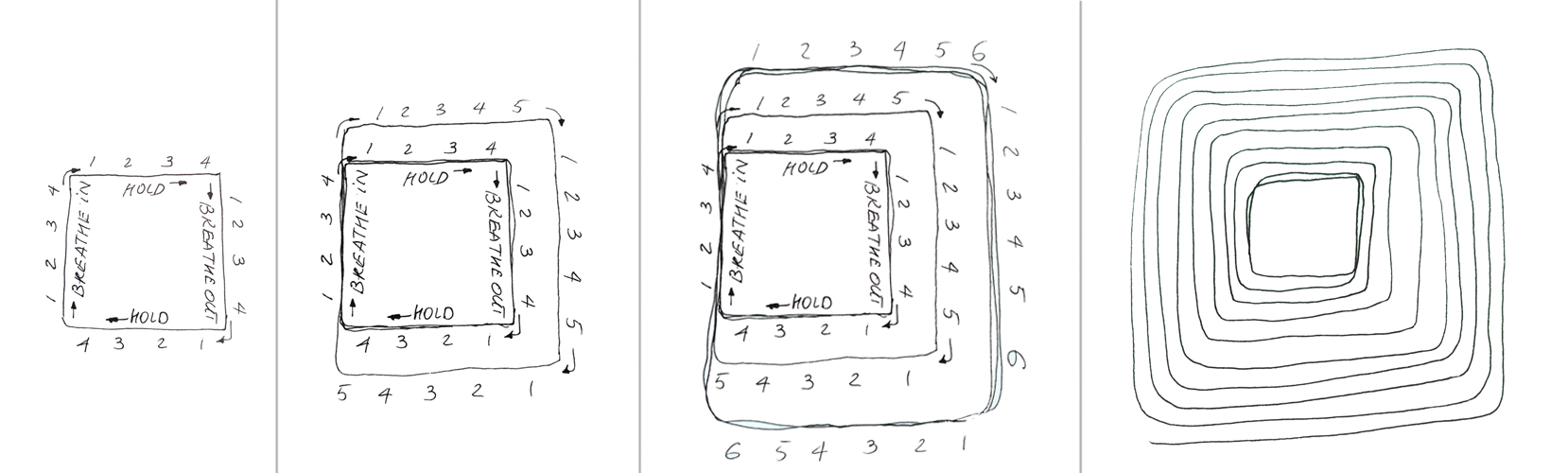
Sample drawing and breathing practice
Why This Works
This kind of exercise draws on several well-established mechanisms studied in neuroscience and behavioral science.
Slow, controlled breathing has been shown to influence vagal tone and support parasympathetic nervous system activation. Predictable motor patterns reduce the brain’s need for constant monitoring and decision-making, allowing attention to settle.
Repetitive hand movements engage sensorimotor pathways that are closely linked to emotional regulation. When these movements are paired with intention and breath, they can help synchronize internal rhythms, reducing physiological arousal without suppressing sensation.
Importantly, the exercise avoids overstimulation. It does not rely on intensity, rapid motion, or emotional provocation. Instead, it works through consistency, rhythm, and simplicity, which the nervous system tends to recognize as safe.
Intention Over Outcome
This exercise is not about creating a particular drawing or achieving a visual result. It is an invitation to notice how rhythm, repetition, and intention influence your internal state.
Some people feel calmer.
Some notice quieter thoughts.
Some simply enjoy the steady motion.
All of these responses are valid. The body already knows how to regulate itself. Sometimes it only needs a simple, predictable structure to remember how.
Rhythm is only the beginning. In Part 2, we look at how structure — the organization of lines and form — deepens the regulating effect of repetition.
Curious to explore NeuroGraphica Art?
Join my email circle and get the Free NeuroGraphica Starter Course, plus biweekly inspiration, course news, and exclusive subscriber discounts.