- Feb 28
The Science of the Line: How Structured Drawing Regulates the Modern Brain
- Alina Smolyansky
- NeuroGraphica and NeuroArt
- 0 comments
From Rhythm to Structure
In the previous post, Rhythm, Repetition, and Intention: How Simple Drawing Can Support Relaxation, we explored how rhythm, repetition, and intentional breathing can support relaxation. Simple, predictable movement helps the body shift toward regulation.
Here, we go one step further. If rhythm is the foundation, structure is the architecture.
The nervous system does not only respond to repetition. It responds to organization. When we draw structured lines, such as grids, mandalas, intersecting networks, we are not merely repeating movement. We are creating order in visible space.
And the brain pays attention to that order.
When Attention Shrinks
Today, our nervous system is rarely at rest. What feels like “low motivation” or “mental fatigue” is often the brain narrowing its attention in response to perceived instability. The amygdala, the region involved in detecting threat, becomes more vigilant when attention weakens.
Unstructured information increases uncertainty, but predictable structure reduces it. A blank page can feel overwhelming. A page gradually organized by lines begins to feel coherent. This is not symbolic. It is perceptual.
Why Structured Drawing Feels Stabilizing
When you draw intentional lines, especially lines that intersect and are rounded into softer transitions, several processes occur at once:
The visual system recognizes pattern.
The motor cortex coordinates steady, deliberate movement.
Attention narrows in a controlled way rather than collapsing from fatigue.
Structured drawing becomes a kind of external scaffold for attention. Instead of the mind scanning for potential threats or distractions, it follows a visible pathway. Line by line, intersection by intersection, the page transforms from chaos into relationship.
This visible organization often mirrors an internal shift: scattered thought becomes sequential; agitation becomes rhythm.
The Role of Integration
In Neurographic Art, sharp intersections are rounded. Corners soften. Lines that once divided begin to flow into one another. Visually, this reduces fragmentation.
Neurologically, smooth, predictable curves are easier for the visual system to process than abrupt angles. The brain prefers continuity. Flow requires less vigilance than sharp disruption.
You could imagine it like tiny springs merging into a wider current — small movements converging into something steady and cohesive.
The act of rounding intersections is simple, but its effect is cumulative. Each curve signals continuity rather than conflict.
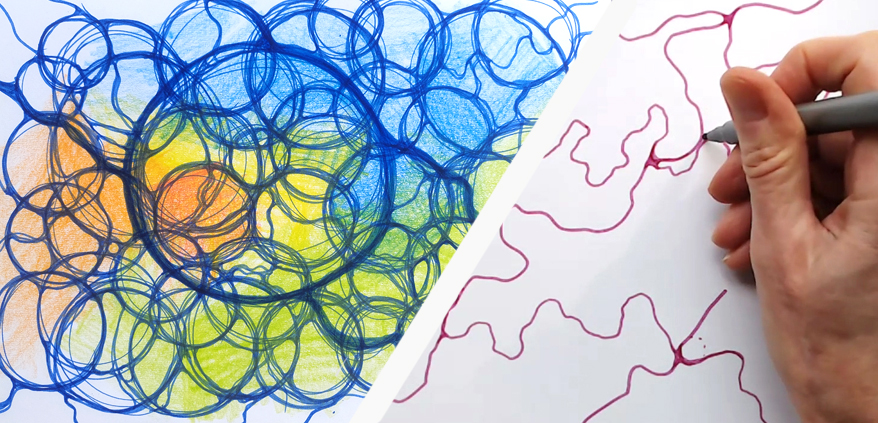
How rounding in Neurographic Art supports our nervous system
Mandalas, Grids, and Repeated Forms
Simple mandalas and geometric repetition operate on the same principle. Symmetry and predictable expansion provide orientation. The eye knows where it is, and the mind does not need to search.
This reduction in search effort decreases cognitive load.
Less cognitive load often means:
fewer intrusive thoughts,
steadier focus,
less background tension.
Structured drawing does not suppress emotion. It creates enough order for the nervous system to settle.
Authority, Not Ornament
This is why structured drawing is more than decoration.
It is not about producing an impressive image. It is about building a perceptual environment where attention can stabilize.
Repetition (as discussed in Part 1) supports regulation, and structure strengthens it.
Together, rhythm and structure create a framework where the nervous system can shift from vigilance toward coherence.
The body already knows how to regulate. Sometimes it only needs visible order to remember.
You may begin simply: a few lines, rounded intersections, a small mandala. Over time, structure becomes less about the page and more about how attention organizes itself.
For those who prefer guided exploration, this is the foundation we develop further in classes.
Curious to explore NeuroGraphica Art?
Join my email circle and get the Free NeuroGraphica Starter Course, plus biweekly inspiration, course news, and exclusive subscriber discounts.