- May 2
The “Ugly” Truth: Why You Don't Like Your Neurographic Drawing (And What to Do About It)
- Alina Smolyansky
- NeuroGraphica and NeuroArt
- 2 comments
It’s one of the most common questions I hear in class: “What do I do if I don’t like my drawing?”
It usually comes at the same moment. You’re halfway through a Neurographic drawing, looking at the page, and the only clear thought is: I don’t like this…
After six years of teaching, I still experience it myself. Some drawings don’t come together easily. The lines feel uneven, the shapes slightly off, the composition unsettled. That part is normal. What’s more difficult is when you reach the end, step back, and the whole image feels flat or even unpleasant to look at. Not just imperfect, but somehow wrong.
Over time, I’ve learned to treat that reaction differently because it is not a failure. It’s information, feedback. It often means the drawing, and more precisely the process connected to it, isn’t finished yet.
The gap between how you see it and how others see it
You may have noticed this before in other work as well. You finish a drawing you’re not happy with, and someone else looks at it and says, “It’s beautiful.” They’re not being polite; they’re simply seeing something different.
When you draw, especially when you’re working through something personal, your attention is not neutral. Every line is connected to a moment in the process: effort, hesitation, frustration.
So when you look at the finished page, you don’t just see the drawing. You also see the experience of making it. In cognitive terms, this is close to what’s called self-referential processing, where perception is shaped by personal involvement.
An observer doesn’t carry that layer. They see the flow of lines, the balance of the composition, the way elements connect across the page.
In a sense, they are responding to the result, while you are still partially inside the making of it.
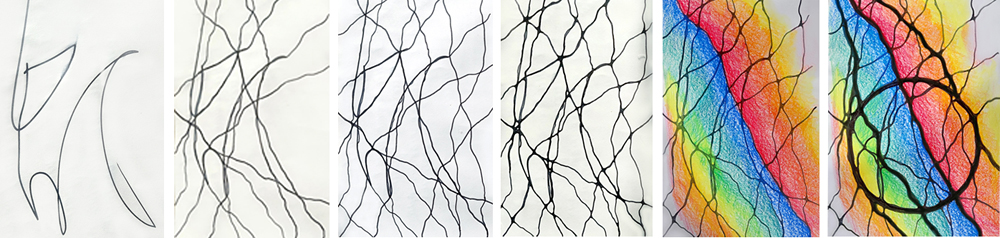
The same Neurographic drawing at different stages. What begins as a loose doodle gradually settles through rounding, added lines, and the integration of color.
Why the drawing needs to work for us
In Neurographic drawing, we’re not only creating an image. We’re working through an image built on lines, intersections, and gradual integration across the page. Because of that, our response to the drawing matters.
If you reach the end and the image still feels tense, fragmented, or uncomfortable to look at, it usually means the visual field hasn’t fully settled. There are still areas where the eye gets interrupted, those sharp intersections, uneven transitions, or disconnected parts.
Our visual system is sensitive to these disruptions. It naturally seeks continuity and smooth transitions, a principle often described in Gestalt psychology as the tendency toward coherence and completion.
This is where the core principles of Neurographic drawing and similar approaches come in.
Rounding, smoothing, and curving lines are not decorative steps. They directly affect how the drawing is perceived. When intersections are softened and lines begin to flow, the image becomes easier to follow as a whole.
The same applies to color and composition. As separate elements gradually connect into a more unified field, the drawing stops reading as fragments and starts functioning as a single structure.
This shift is subtle, but noticeable. Attention moves differently. Instead of stopping at points of tension, it travels across the page more continuously. That is often the moment when the drawing begins to feel more resolved.
Not perfect, but coherent enough that you can stay with it without resistance.
What to do when you reach the “I don’t like this” stage
If you find yourself there, the most useful move is not to stop immediately, but to adjust how you’re working.
A few simple steps can help you move forward:
Turn the drawing upside down
This interrupts object recognition and allows you to see lines, angles, and relationships more objectively.-
Return to rounding and smoothing
Look for sharp or unfinished intersections and soften them.Sharp angles tend to feel tense. They catch the eye and interrupt its movement. Curved lines do the opposite: they allow the gaze to move more smoothly across the page. Even small adjustments here can noticeably change how the drawing holds together.
-
Work with color more broadly
Instead of staying within small areas, allow color to move across the page.When color is applied in isolated sections, the drawing can feel separated into parts. The eye moves from one area to another without connection.
When color flows across boundaries, it begins to link those parts together. The image becomes easier to take in as a whole, rather than as separate pieces. Even a light wash or a few connecting areas can shift the drawing from scattered to unified.
-
Give it time
Sometimes the most effective step is to pause. Looking at the drawing the next day often creates enough distance to see it more clearly.When you’re in the middle of the process, perception is shaped by effort, expectation, and emotional intensity. With time, that layer settles. What felt unresolved can appear more balanced simply because you’re no longer inside the moment of making.
Sometimes the shift doesn’t come from doing more, but from seeing differently.
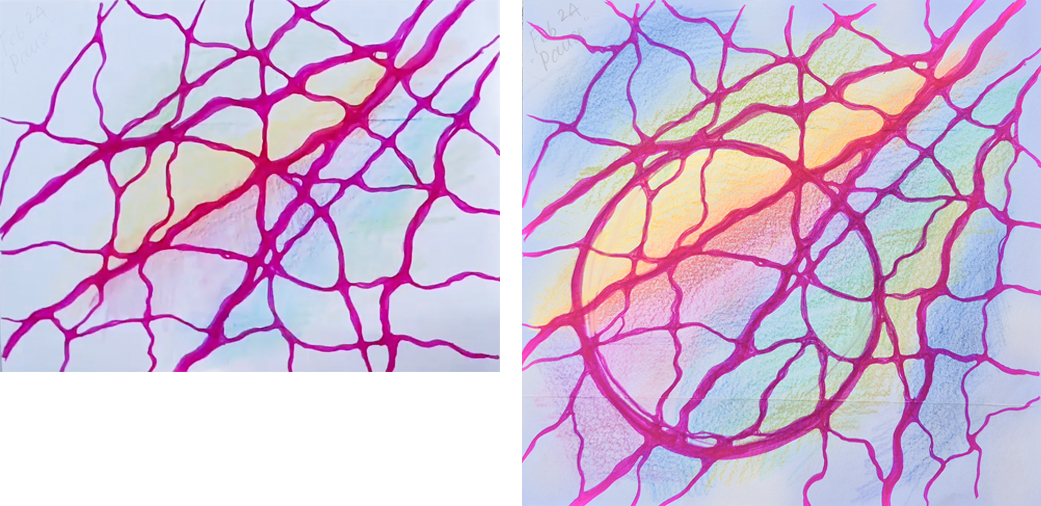
The same drawing before and after additional work. Adjustments in line and color can significantly change how we perceive our art.
For those who are curious
From a broader perspective, this process connects to how we perceive visual information. We naturally look for continuity and coherence. When an image feels fragmented or unresolved, it requires more effort to take in. When it becomes more integrated, it feels easier to process as a whole.
That sense of ease is often what we experience as aesthetic satisfaction.
It also explains why relatively small changes, such as softening a few intersections, adjusting the flow of lines, or unifying areas through color, can significantly change the experience of a drawing.
You’re not just changing how the drawing looks. You’re changing how it is perceived.
Closing note
Most Neurographic drawings don’t resolve in a single session. They often reflect complex areas of experience, for instance, work situations, relationships, emotional patterns, things that cannot be fully processed at once.
In these cases, it can be more natural to treat the work as something that unfolds over time. One drawing may focus on one aspect of a theme, another on a different layer.
Instead of expecting closure in one sitting, the process becomes something you return to. It continues later, developing in layers rather than ending at a single point.
Some drawings are not meant to be completed immediately. They are meant to evolve.
Curious to explore NeuroGraphica Art?
Join my email circle and get the Free NeuroGraphica Starter Course, plus biweekly inspiration, course news, and exclusive subscriber discounts.
2 comments
Hello, Alina. Thank you so much for sharing this information. I've experienced that very often: not caring too much about the end results of my drawings. I often compare my drawings to others', thinking theirs is better than mine. I have a question. In your closing notes, you mention that usually more drawings are required to make a significant and noticeable change to a topic. You mention that some drawings are meant to evolve. I'm assuming that we need to draw some more on that same topic. For example, if we started on the topic with ARL or ARI, do we need to do that again, or do you suggest another algorithm to evolve with the topic? I hope you understand my question. Thank you.
Hello Lucie, thank you for your thoughtful comment.
What you mentioned about needing more than one drawing is very true. A single drawing can open something, but meaningful change usually happens through repetition and continuity over time. We’re often working with patterns that have been forming over many years through thoughts, reactions, and habits, so it’s not always realistic to expect one session to shift that completely. Like any new skill, it develops through consistent practice. At the same time, the intensity of focus also matters.
Sometimes one drawing is enough to create movement. Other times, it helps to return to the same theme and continue working with it from different angles.
If you start with ARL, which is often used to remove obstructions, that can already create enough shift for things to move more naturally. From there, you can either stay with that effect and allow it to unfold, or continue working on the same topic using other approaches, depending on what feels needed.