- Jul 4
How I Overcame the Fear of the Blank Page Through Art Journaling and NeuroArt
- Alina Smolyansky
- NeuroGraphica and NeuroArt
- 2 comments
Do you experience the fear of the blank page?
I noticed something about myself despite many years of experience as an artist.
Whenever I bought a beautiful new journal with the intention to start writing in it, I often didn't. Sometimes I barely opened it and kept saving it for "something special."
The cleaner the pages and the nicer the paper, the more difficult it became to make the first mark. Somehow, my thoughts did not feel important enough to deserve that first page.
I noticed the same thing with drawing. I had a beautiful pad of Arches watercolor paper that I kept saving for a special project. I preferred using something less precious. The same happened with Neurographic Art. A beautiful Bristol vellum album I bought for a special drawing project is still waiting for its moment.
The problem was not the paper. It was the expectation attached to it.
A perfect page created pressure. The drawing or writing needed to be meaningful enough, beautiful enough, worth using that page.
Recently, something changed.
I wanted to start keeping a journal again, partly to document my thoughts and partly to maintain the habit of handwriting.
I had an art journal for over a year. A few days ago, I did something without thinking too much. I glued some leftover pieces of coloured paper from another project onto the page. I don't know what prompted me. Then I experimented with flower printing, including some marks that were not exactly what I expected.
The page was no longer perfect.
The next day, something surprising happened. I opened the journal and started writing naturally.
The barrier was gone.
The page already had a history. It was no longer something precious that I could ruin. It became a space where I could continue.
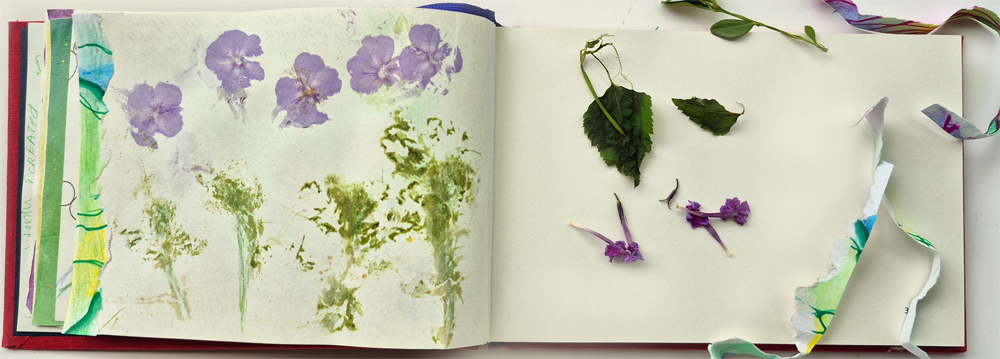
What helped me overcome the fear of the blank page - the first imperfect mark.
I started noticing the same thing in my drawing practice.
Some of my best sketches happen on scrap paper, old pages, or during preparation for a class. I have an intention, but I do not expect a final result. I simply explore.
And often those spontaneous sketches solve problems, reveal ideas, and honestly feel more alive than drawings where I carefully plan everything from the beginning.
The same idea has influenced how I now approach Neuro Art projects.
Adding a simple background, collage element, texture, or natural print changes the relationship with the page. It makes it feel less like a pursuit of the final result and more like an invitation.
Perhaps the blank page was never the real obstacle. Perhaps it was everything I expected from it.
By adding a few scraps of paper, a flower print, or an imperfect background, the page no longer asked me to create something important. It simply invited me to continue.
Interestingly, this simple observation became one of the inspirations behind my new summer course, Reconnect with Yourself through NeuroArt. We don't begin with a pristine white page. We begin by creating a surface that already has life, texture, and history. Looking back, I think that's one reason the drawing grows so naturally.
I still love beautiful journals and good paper.
But now I know that sometimes the first thing they need is not a perfect idea.
Sometimes they just need the first imperfect mark.
Curious to explore NeuroGraphica Art?
Join my email circle and get the Free NeuroGraphica Starter Course, plus biweekly inspiration, course news, and exclusive subscriber discounts.
2 comments
Yes! --> "The problem was not the paper. It was the expectation attached to it." This is exactly my fear of the blank page and I love your idea of starting to mark the page by removing the expectation in the first place with the "imperfect mark" by playing, experiencing, and exploring with no expectations. I am going to try this, Thank you!!
Many thanks, Tracy!
I've been writing in my journal, and it's been so much fun decorating the pages before I write. I'm gradually developing my own style, exploring what best reflects my ideas rather than simply creating for the sake of creating.
Making "imperfect marks" has become an important part of the process. I'll share some pages from my journal soon.