- Mar 28
Why the Brain Avoids Thinking — and How AI Makes It Easier Than Ever
- Alina Smolyansky
- NeuroGraphica and NeuroArt
- 2 comments
In the previous article, AI Fatigue and the Return to Simple Drawing and Writing by Hand, I described something unexpected I noticed in my own work.
The more I relied on AI tools to help with writing and organizing ideas, the harder it became to enter my own creative flow.
At first this felt paradoxical. If technology saves effort, why would thinking become harder?
But the explanation may be simpler than it seems: the brain is designed to conserve energy whenever possible.
Why Does the Brain Try to Save Effort?
The brain is powerful, but it is also expensive to run.
Although it represents only about 2% of the body’s weight, it consumes roughly 20% of the body’s daily energy. Because of this, the brain constantly looks for ways to reduce effort.
Psychologist Daniel Kahneman described this tendency in his research on decision-making. The brain prefers fast, automatic thinking and tries to avoid slow, effortful thinking whenever possible.
This is not laziness, but an efficient energy-saving strategy.
Whenever a task can be simplified, automated, or delegated, the brain will gladly accept that option. Today, we have tools ready to do exactly that.
What Happens When Thinking Is Outsourced?
Search engines retrieve answers instantly.
Software organizes information.
AI tools generate text, summarize ideas, and propose solutions.
The brain adapts quickly to these conveniences. Instead of generating ideas, we begin selecting between options.
Instead of thinking through a problem, we choose from suggested solutions.
Over time this subtle shift can make original thinking feel heavier, almost like physical exercise after a long period of inactivity.
What I Learned From Handwritten Notes
I noticed something similar long before AI appeared. When I began university, I proudly brought my first laptop to lectures. Typing notes felt modern and efficient.
But after a while I noticed something surprising. My notes looked organized and polished, yet I remembered far less.
Eventually I returned to handwritten notes. They were messier, full of arrows, abbreviations, and small diagrams, but I understood the material more deeply and remembered it better.
Only later did I discover that research supports this experience:
Writing by hand activates more brain areas involved in learning and memory than typing.
Why Do Drawing and Handwriting Reactivate the Brain?
Drawing and handwriting activate networks that connect movement, perception, language, and attention. Because the hand must form every letter or line, the brain participates directly in the process.
I experienced this again years later while completing a year-long Neurographica diploma program. The training involved drawing almost every day using structured exercises. After several months I noticed something unexpected: my concentration had improved, and it became easier to stay focused on complex tasks.
The exercises themselves were simple. But the combination of intention, attention, and coordinated hand movement gradually sharpened my ability to think clearly.
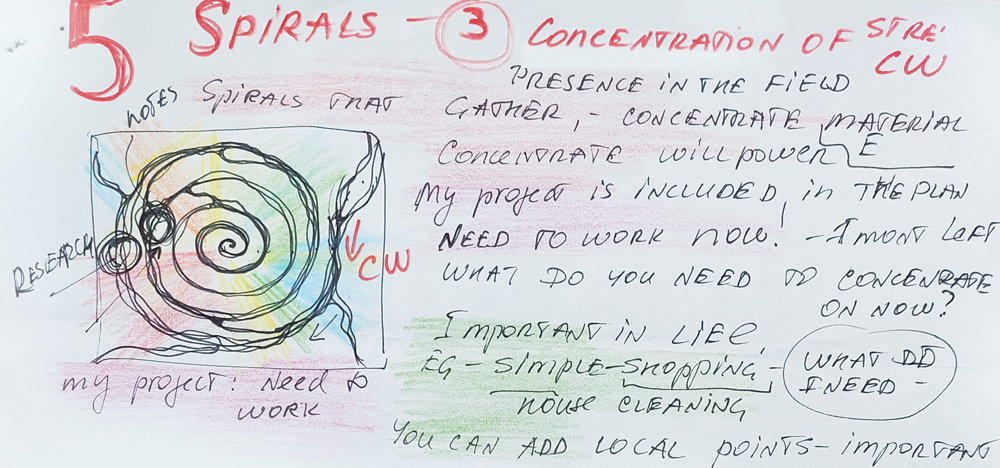
Moreover, I continue writing notes by hand for the classes I offer.
Small Actions That Reactivate the Mind
The encouraging part is that re-engaging the brain does not require complicated techniques.
Simple actions can already help:
• writing notes by hand
• sketching simple lines or patterns
• drawing intersecting lines and rounding their corners
• constructing basic geometric shapes
These movements reconnect attention and action. The brain shifts from evaluating options to creating something directly.
You might try a small experiment:
Take a sheet of paper.
Draw several intersecting lines.
Then slowly round the corners where the lines meet.
Move slowly and allow your eyes to follow the movement of the pen. For many people, even this small exercise can bring a surprising sense of calm focus.
If you enjoy geometric forms, you may also explore structured drawings such as yantras, where compass-based shapes combine with flowing lines.
Sometimes a few minutes of drawing or handwriting is enough to remind the brain how to participate actively again.
A Personal Realization
When I first began exploring AI tools, I was excited about their possibilities. I even considered integrating more technology into my work — digital drawing, AI-assisted analysis of drawings, and new ways of combining psychology and artificial intelligence in creative practice.
But after some time I noticed something unexpected in myself.
The more tools I used to accelerate creative work, the more disconnected I felt from my own thinking and from the physical experience of creating. My attention was constantly fixed in the narrow space between my eyes and the screen.
That experience gradually changed my direction. Instead of accelerating everything, I began to value the opposite: mindful drawing, handwriting, and thinking with pen and paper.
Not as a rejection of technology, but as a conscious counterbalance.
Technology helps us produce faster. But creativity often develops more fully when the mind has time to explore, hesitate, and form connections through movement and attention.
Human Creativity Still Begins With the Hand
This is why I now intentionally emphasize hand drawing, handwriting, storytelling, and simple structured exercises in my work.
These practices engage the brain in ways digital tools cannot fully replace.
In a world where machines can generate almost anything instantly, perhaps one of the most valuable abilities we can preserve is the capacity to think and create through our own movement and attention.
What interests me most is exploring how human cognitive creativity can be supported through hand movement through drawing, writing, and simple visual structures that reconnect the mind with the body.
Technology will continue to evolve rapidly. But the relationship between the brain, the hand, and the act of creating has shaped human thinking for thousands of years.
My goal is not to avoid technology, but to help preserve something essential and deeply human:
our ability to think, feel, and create directly with our own mind and through our own hands.
If this resonates with you, and you would like to explore this in a more structured way, I’m opening a small group for Neuro Geometry Foundations, starting April 7.
It’s a short guided series where we work with simple geometric forms and lines to support focus, reduce mental overload, and re-engage attention through hand movement. You don’t need any prior experience. Just a pen, paper, and a willingness to slow down.
✨You can find the details here: Neuro Geometry Foundations: From Scattered to Sacred Calm
Have you noticed any changes in how you think or concentrate when using AI tools or digital systems? Please share in the comments.
Curious to explore NeuroGraphica Art?
Join my email circle and get the Free NeuroGraphica Starter Course, plus biweekly inspiration, course news, and exclusive subscriber discounts.
2 comments

This is so true. I find AI helps my neurodivergent mind structure things in the appropriate manner(like when I am not sure the right way to word something) but other than that is is a drain on the mind and natural resources so I use it only when I necessary. Great post. Aldo, as someone who is dyslexic it was interesting to me to find that cursive handwriting was beneficial. I used this when homeschooling my daughter with dyslexia/autism/adhd. It’s that connection of writing the letters and connecting them with cursive that helps imprint the spelling memory. That’s often why if someone asks how to spell something I have to write it first rather than peak it out.
Thank you for sharing your perspective. It really adds depth to the discussion. I love how you describe AI as a tool for organizing thoughts and writing while still being mindful about its use. Your experience with cursive handwriting is fascinating; it really highlights how the act of connecting letters can reinforce memory, especially for neurodivergent learners. I remember that in the old days we were taught to connect letters in writing. I also find it intriguing to think about ancient scripts without spaces between words. Imagine how that might have shaped the way people saw and processed the world. Your reflections really give me a new appreciation for the connection between writing, memory, and perception.