- Mar 14
AI Fatigue and the Return to Simple Drawing and Writing by Hand
- Alina Smolyansky
- NeuroGraphica and NeuroArt
- 0 comments
Recently I began noticing something paradoxical: the more helpful digital tools became, the harder it felt to access my own creative flow.
I genuinely enjoy using AI tools. They help with editing, structuring ideas, and sometimes getting past the discomfort of a blank page. For someone who writes newsletters, blog posts, and teaching materials regularly, having this kind of support can feel like a relief. The pressure of starting from nothing becomes much lighter.
But after a while, I began noticing something else. The more I used AI for writing and organizing ideas, the harder it became to rely solely on myself and enter my own creative flow.
At first the change was subtle. I found myself hesitating before writing. I truly felt that I didn’t know what to say, and my hand instinctively reached for ChatGPT to brainstorm topics.
Then I noticed something even more disturbing. With AI tools, drafts can be rewritten instantly and endlessly. However, instead of reducing the time and effort involved, the process began to fill with small decisions.
Should I keep this sentence?
Should I rewrite it to reflect keywords better?
Should I ask the AI for another version?
And then, eventually: should I ask the AI which version is better and trust its response rather than my own judgment?
Gradually, the work became less about creating and more about supervising and engaging in non-stop digital conversation.
Eventually I began to wonder whether this was only my experience, or whether something similar was happening to others.
When I started looking into it, I found that more people have begun describing a similar feeling. Terms such as AI fatigue, decision fatigue, and cognitive overload are appearing more often in discussions about digital work. Many people appreciate the speed and efficiency of AI tools, but also notice a kind of mental exhaustion that comes from constantly evaluating, correcting, and choosing between generated options.
This does not mean the technology itself is harmful. In many ways it is remarkably helpful.
But it raised a deeper question for me: what happens to our own thinking and creativity when too much of the process is delegated?
Returning to Hand Drawing and Writing
What helped me most was surprisingly simple. One day I decided to experiment with collage and drawing while recording a short video. I spent quite a lot of time on it, and the project itself did not turn out as I had hoped. However, something unexpected happened.
Instead of feeling frustrated about the time spent, I felt refreshed. The tactile experience of working with real materials, such as handling twigs and leaves, searching for scraps of drawings, tearing paper, drawing lines with awkward handmade brushes, brought me back into a very different state of mind.
It felt like a signal to return to small forms of handwork: writing notes by hand, drawing geometric shapes, making simple lines on paper.
These actions do not produce immediate results. They are slower than typing or editing digital text. But they engage the mind in a very different way. They also invite a form of mindfulness that is not easy to maintain while staring at a screen most of the day.
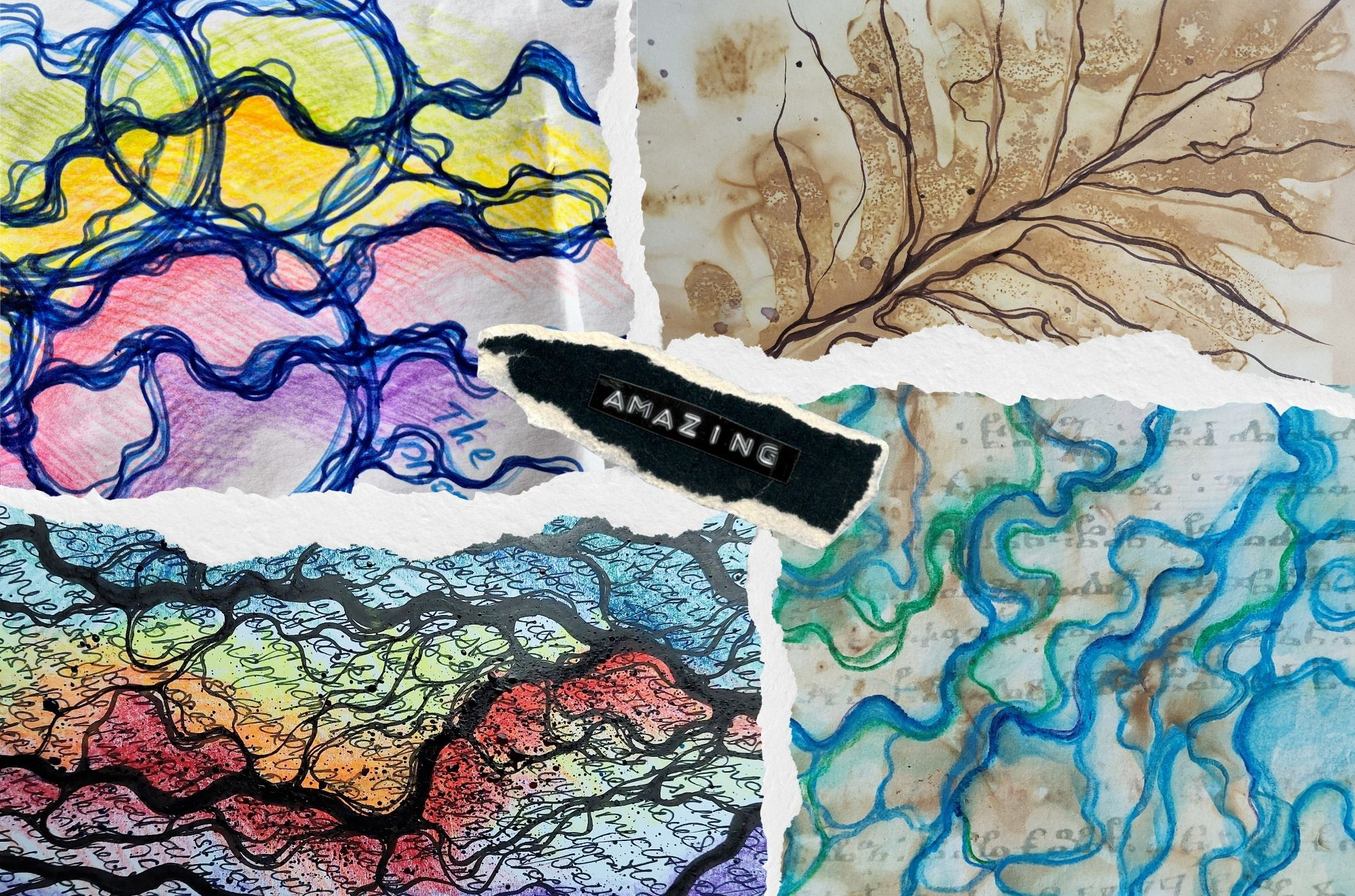
Examples of Neuro Arts, exploring how the arts change the brain
When the hand moves across paper, attention follows the movement. There are fewer decisions to supervise and fewer options to evaluate. Instead of managing generated content, the mind participates directly in creating something.
This shift can be surprisingly refreshing.
Even simple structured drawing, such as repeated patterns, expanding mandala forms, or structured geometric compositions, can bring awareness back to ourselves rather than to external digital input.
As a result, the brain stops jumping between choices and begins to follow a sequence of small, deliberate actions. Gradually, this can bring a state that feels quieter and more grounded.
Many traditional practices, from calligraphy to geometric drawing, use this principle. The hand moves, the mind focuses, and a sense of calm clarity begins to emerge.
For me, this return to simple handwork became an important counterbalance to the speed and convenience of digital tools.
A Small Invitation to Experience Neuro Arts Through Geometric Drawing
If you notice a similar kind of fatigue, you might start with something very simple.
Take a sheet of paper. Draw a few lines. Let them intersect. Slowly round the corners where they meet.
There is no goal here. Just a small shift from thinking to doing.
These kinds of structured, repetitive movements can help the mind settle, not by removing thoughts, but by giving attention something clear and steady to follow.
If you would like to explore this more deeply, I’m opening a small group for a course called Neuro Geometry Foundations, starting April 7.
It’s a short, guided series focused on simple geometric forms and flowing lines. The emphasis is not on technique, but on working with structure, rhythm, and attention in a way that supports mental clarity.
You can find the details here: Neuro Geometry Foundations
If you prefer to begin on your own, I also have a few earlier guided drawings available as free practice sessions.
Or explore the full series here with a special 40% discount:
Neuro Drawing & Sacred Geometry - Yantras for Chakras
How the Brain Manages Effort and Attention
Many people are now describing a sense of fatigue when working with constantly generated information and endless digital options.
In the next article, I will explored why this happens from the perspective of how the brain manages effort and attention and why simple practices like drawing or writing by hand can help restore balance. Why the Brain Avoids Thinking?
Curious to explore NeuroGraphica Art?
Join my email circle and get the Free NeuroGraphica Starter Course, plus biweekly inspiration, course news, and exclusive subscriber discounts.